
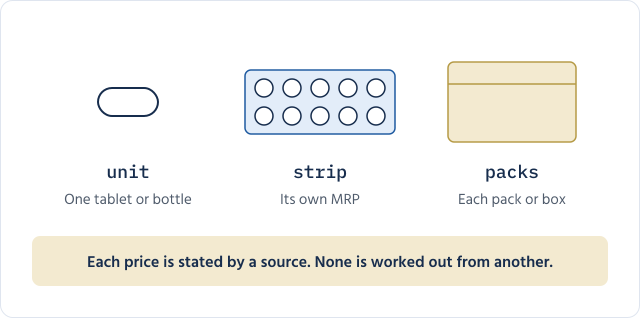
Price is the field pharmacy apps get wrong most often. A tablet has an MRP per tablet, the strip has its own, and a box of three strips may have a third. Sources rarely state all three, and they do not always agree. This is how Oushodh handles medicine prices, and why.
What is MRP?
The maximum retail price: the most a shop may charge for a medicine. It is printed on the pack and set for each medicine. Oushodh gives MRP only. What a shop actually charges, after a discount, is never in the data.
Which prices does a medicine have?
Every price comes in prices, in Bangladeshi taka:
| Part | What it is |
|---|---|
unit |
The MRP of one unit, such as one tablet or one bottle |
strip |
The MRP of one strip, and how many units it holds |
packs |
The MRP of each pack or box, cheapest first |
sizes |
The unit price in each pack size, when a source gives several |
Each price names the source that stated it. Any part no source states is null.
Why not work out the strip price from the unit price?
Because it is often wrong. A strip’s MRP is set on its own, and it is not always the unit price times the number of tablets. So Oushodh gives only prices a source states. An app that needs a strip price and finds null should show that there is none, not multiply.
Which source wins when two disagree?
For each kind of price, the first source that states it. The DGDA price list always comes first. So when DGDA states a unit MRP, that is the unit price, whatever another source says. A strip price can come from another source when DGDA does not state one.
What about a cream with a different price for each tube?
Then there is no single unit price. A 15 gm tube and a 30 gm tube of the same cream each have their own MRP, and dividing one by the other would invent a third. The API lists the price of each size in sizes, cheapest first, and leaves unit as null. When a person has chosen one size as the medicine’s unit price, unit holds it and sizes still lists them all.
How should an app show prices?
- Show the price the customer is buying: per strip at the counter, per unit in a prescription.
- Show the source next to it when someone may question it.
- Treat
nullas “no price stated”, never as zero. - Read
prices, not the olderpricefield kept for older clients.
The medicine object reference lists every price field.