Every list of Bangladesh’s medicines spells things its own way. One source writes “APC Pharma Ltd.”, the register writes “APC Pharma Limited”. One lists a brand at its Gazipur plant, another at the head office. Put two lists together naively and the same medicine shows up twice, or two medicines collapse into one. This is how Oushodh decides which rows are the same medicine.
What counts as one medicine?
One brand, in one strength and dosage form, from one company. Napa 500 mg Tablet and Napa 500 mg Suppository are two medicines. Napa 500 mg Tablet made in two places is one.
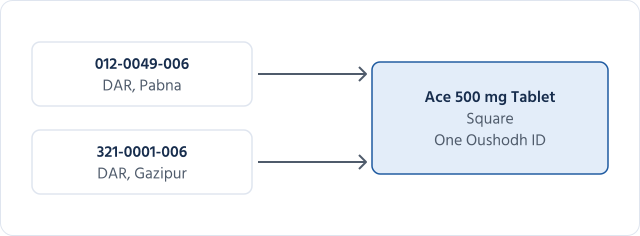
That rule matters because DGDA can give one medicine more than one registration. Ace 500 mg Tablet from Square holds two DAR numbers, 012-0049-006 (Pabna) and 321-0001-006 (Gazipur). In Oushodh it keeps one ID and lists both.
Why start from the DGDA register?
Because it is the official record. The DGDA sources are imported first, and every other source is matched onto the medicines they made. On a medicine DGDA lists, only the register writes the brand, strength, generic, dosage form and manufacturer. Other sources still add what the register does not have, such as pack sizes, pictures and descriptions.
A medicine no registration links to is still kept, with a Not DGDA listed badge, and loses the badge when a later import links one.
How are DAR numbers linked to medicines?
DAR numbers are read lowest first. For each one:
- A person’s earlier decision wins.
- A medicine with the same trade name, dosage form and company links to it. When several share those, the strengths decide.
- A row that looks like a medicine DGDA did not make, such as the same brand or the same generic, strength and company, becomes an issue for a person to review.
- Otherwise the DAR number makes a new medicine.
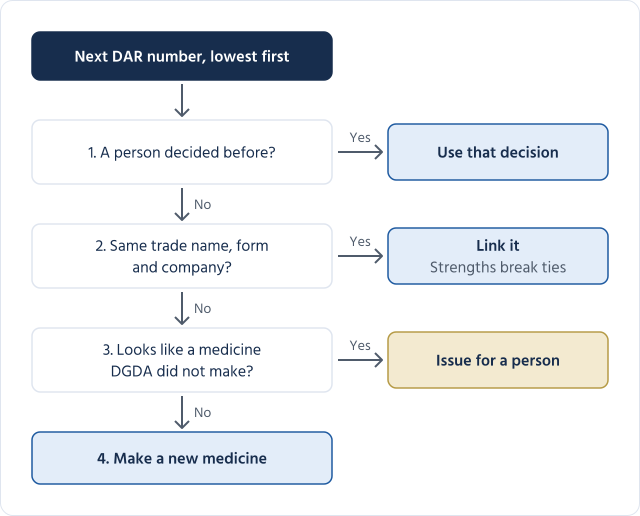
Nothing in step 3 is guessed. A person links the row to the medicine it is, or makes it a new one.
How are manufacturer names matched?
Names are compared without their legal words: Limited, Ltd, PLC, Pharma, Pharmaceuticals, Laboratories, Company and others. So “APC Pharma Ltd.” and “APC Pharma Limited” are one manufacturer.
That rule has edges. Reliance Laboratories Ltd. and Reliance Pharmaceuticals Ltd. are different companies, and become the same name once the legal words are gone. On 9 Nov, 2026 the rule kept 10 of 955 DGDA companies apart that would otherwise have merged, and each was flagged for a person to check.
DGDA also lists some companies at one plant, after a comma: “Square Pharmaceuticals PLC, Gazipur”. A medicine made there now links to the company. On 11 Nov, 2026 that moved 3,018 medicines from 17 plants to their companies.
A company’s divisions, such as its herbal or ayurvedic division, are linked to the company after a person checks the link, so its medicines show one manufacturer.
What happens when sources disagree?
| What differs | What Oushodh shows | What it keeps |
|---|---|---|
| A brand or generic spelling | DGDA’s | The other spelling, as an alternate name search finds |
| A manufacturer name | DGDA’s | The other name, on the medicine page |
| A price | Each price a source states, with that source | Every source’s price |
| A value no source gives | null |
Nothing is made up |
The alternate names are why a search for a spelling that only a pharmacy site uses still finds the medicine.
Why does a person review the hard cases?
Because a wrong match is worse than a slow one. If two medicines merge, an app shows the wrong price or the wrong maker. So the code decides only what it can decide for certain, and the rest waits on a review queue until a person has looked at it.