Anyone building a pharmacy, clinic or health app for Bangladesh ends up at the same place: the Directorate General of Drug Administration (DGDA) and its register of medicines. It is the official record. It is also not built for apps, and the gap between the two is most of the work.
What is the DGDA medicine register?
The list of medicines registered for sale in Bangladesh. DGDA keeps two registers on one site:
| Register | What it covers | On 9 Nov, 2026 |
|---|---|---|
| Allopathic | Modern medicines | 41,490 rows from 334 manufacturers, 41,116 DAR numbers |
| Traditional | Homoeopathic and biochemic, herbal, ayurvedic and unani | 18,115 rows from 621 manufacturers |
The main DGDA site, dgda.gov.bd, carries notices and publications. The registers themselves are on a separate server.
What does each register row hold?
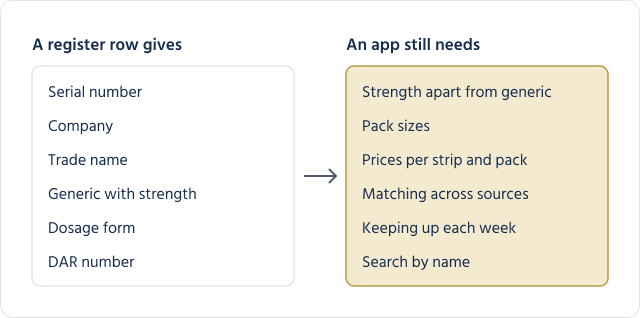
Six columns: a serial number, the company, the trade name, the generic name with its strength, the dosage form and the DAR number, DGDA’s registration number. The Allopathic register adds a price page for each medicine with its MRP. The traditional registers have no price pages.
That is enough to say a medicine is registered. It is not yet enough for an app, which also needs the strength apart from the generic, pack sizes, prices per strip and per pack, and a way to search.
How is the register served?
As web pages, not an API. Each page returns its whole table at once, with no paging, and the server builds the page before it answers, which can take up to a minute. The registers are served over plain HTTP from an IP address.
There is a CSV export of the Allopathic medicine list. It holds the same six columns, without the prices.
What does an app still have to build?
- Matching. The same medicine is spelled differently in other sources, and one medicine can hold two DAR numbers. Something has to decide which rows are the same medicine.
- Prices. Price pages are one per medicine, and some give a different price for each pack size.
- Repeats. A register can list a DAR number on more than one row.
- Keeping up. The register grows every week. The Allopathic register added 191 rows between 9 and 28 Nov, 2026.
- Search. A person types “napa”, not a DAR number.
Where does Oushodh fit?
Oushodh starts from these registers, matches every other source onto them, has a person review what the matching cannot decide, and serves the result through one API with search. How Oushodh matches one medicine across sources explains the matching step by step.